
(This article was published in Steam World Number 398 – August 2020, and is reproduced here by kind permission of the author).
A few memories which I hope will show that trainspotting in an unfashionable location wasn’t necessarily boring – indeed it could be just the opposite.
They say that railways run in the blood and in my case it certainly does, although I only found out about it very recently. Whilst researching my “Family Tree”, I discovered that no fewer than 3 of my direct ancestors worked on the railways in various jobs at the end of the 19th and start of the 20th Centuries! One was a porter, one a fireman and cleaner and the third a driver.
I spent the first 19 years or so of my life living at number 19 Mill Street, Walsall – not more than a stone’s throw from Ryecroft Junction and its attendant loco shed (3C). 3 doors away, at number 13, lived “Uncle” Bill Hackett, a kindly man who was a driver at Ryecroft. Family friends were always “uncle” and “auntie” to us kids. I must have shown some very early interest in trains because when I was 5 or 6 years old, “Uncle Bill” took me to the shed to have a look round. Standing in awe of these giants was enough to spark my interest, but I think it was probably the smell of the place which hooked me completely. I was a regular visitor after that until authority took a hand. However, lots of young lads in the area were already avid trainspotters, and I duly took my place amongst them, either close to Ryecroft Junction signal box, or more likely in the patch of waste ground which stood between the Wolverhampton (via North Walsall) and Rugeley lines. This could be accessed quite easily by walking to the end of Mill Street and going through the derelict fence which was supposed to be a barrier. Of course, this was in the days where youngsters could go about their business without risk of molestation and there were plenty of older lads who were charged with looking after us younger fry.
Although Walsall was always considered to be a bit of a backwater where railways are concerned, there were often pleasant surprises to be had. Ryecroft Junction itself was apparently unique in this country, being a 4-way “fan” junction. There were lines to Wolverhampton via Short Heath and Wednesfield; Rugeley via Cannock; Burton via Pelsall and Lichfield and Birmingham via Sutton Park. In fact, there could be an argument for saying that it was a 5-way junction as the shed lay in between the Rugeley and Burton lines.
With the number of coalmines in the South Staffordshire area, it was inevitable that the bulk of traffic was coal, but there was plenty of other freight making its way to and from Bescot yard in particular. Local passenger trains ran through Ryecroft to Rugeley, to Burton via Lichfield and to Birmingham via Sutton Park and Saltley. In the reverse direction, most of the Rugeley trains continued to Birmingham New Street, whilst the Burton trains ran through to Wolverhampton. These locals were usually handled by Stanier 2-6-4 or 2-6-2 tanks from Ryecroft, Aston and Monument Lane, supplemented by Ivatt 2-6-2 tanks. Occasionally a Black 5 put in an appearance, as did the odd 4F and, rarely, a Saltley Fowler 2-6-4 tank. However, the steam era on local trains did not last too long as virtually all were dieselised and Ryecroft shed became a D.M.U. depot by 1958, an occurrence for which I have still not forgiven BR! Freight was predominately in the hands of Super D 0-8-0s (Duck Eights to us locals) which wheezed their way hither and thither, occasionally being double-headed on trains to Walsall Power Station at Birchills. A particular favourite was the almost poetic sounding “ninety-ninety nine” (49099). These were supplemented by 4F, 3F and 2F 0-6-0s. Longer distance trains from the East Midlands brought Stanier 8Fs from Toton, Westhouses, Hasland and Barrow Hill and 9Fs from Toton, Leicester and Wellingborough. Rarer visitors included WD 2-8-0s from Colwick, Mexborough, Frodingham and Immingham. As time progressed, the 0-8-0s were phased out in favour of 8Fs although 4 or 5 continued to put in sterling work until the end of 1964. During late 1961 and early 1962, Burton shed received an influx of displaced Jubilees from other Midland line sheds and some of these found occasional use on freights in the area. These included one or two hitherto rarities and I vividly recall copping 45579 “Punjab” coming off the South Staffs line with a freight whilst I was walking home from school one day. This had for some time previously been a Kentish Town loco so only likely to have been seen on a rare visit to Derby.
Although most local passenger services had become D.M.U. operated, there was an evening workman’s train from Duddeston to (from memory) Brownhills which remained loco hauled to the last. This was an Aston turn and their small “Mickey Mouse” Ivatt 2-6-0s were regulars. However, it seems that if these were not available, Aston would use anything to hand. Jubilees, Scots and even the occasional Brit put in appearances. Odd to see one of those giants on a local, but totally incongruous when seen half an hour or so later bringing the empty stock back tender first! In the summer of 1962, Aston received 4 Standard Class 4 2-6-0s, 76020/22/23/51 – the first of the class to be allocated to the area – and each of these appeared more than once. To emphasise this variety, on the Walsall Local History website is a picture of this train in 1960 which shows it with 70051 at its head, whilst another picture on the same site shows the same train on a different date with 4F 0-6-0 44514 doing the honours!
Along with the mundane, however, was the constant feeling that something special may turn up. In the summer in particular, some Birmingham to Manchester and Liverpool trains were routed via Walsall, Ryecroft and Rugeley being hauled mainly by Black 5s with the occasional Pate, Jube or Scot. Summer Saturdays provided something a bit different. After Saturday morning chores and errands, and provided we were not going to Birmingham, Lichfield or Crewe, we would gather at the usual spot in pure anticipation. Shortly after 11 o’clock, the peg would come off on the Sutton Park line and a pair of locos coupled together would come down the bank from Lichfield Road Junction and run through to Walsall station. These were the locos for the Manchester to Bournemouth “Pines Express” and its relief, which I believe on occasions started at Liverpool, both of which were scheduled to change locos at Walsall. Usually it was a pair of Black 5s, but occasionally it was a Jubilee and Black 5 and, very rarely, 2 Jubilees. After these had passed, it was a brisk walk into town and a 1d (or was it 2d?) Platform Ticket to see what delights would bring in the 2 trains from the north. I have no idea what depot was allocated to work the Pines but it seemed to me that anything that was available would be used. Jubilees were the commonest and some of my memories include 45553 Canada, 45556 Nova Scotia, 45706 Express, 45733 Novelty and 45734 Meteor. Scots to appear included 46133 The Green Howards, 46158 The Loyal Regiment and 46159 The Royal Air Force. These 3 in particular stand out because it was my only sighting of each of them! 45500 Patriot did make the journey at least once to my knowledge as did 45519 Lady Godiva, and 70031 Byron also headed the train at least once. The Liverpool train was almost inevitably Black 5 hauled, although again, an occasional Pate, Jube or Scot appeared. On occasions, I would be back at Ryecroft by about 3pm for the northbound journey of the Pines. Usually this was a Saltley Black 5 but on occasions, presumably the booked locomotive having failed in the Bath area, a Barrow Road Jubilee substituted. I have a vivid memory of this train being hauled by 45682 “Trafalgar”, it being when the loco was just ex works and in immaculate condition. This ritual continued until 1962, after which these trains were diverted to another route.
But back to Ryecroft and some of the other joys which surprised us. 1957 was a momentous year. During the summer, nearby Sutton Park was host to the World Jamboree of Boy Scouts and numerous special trains headed through Ryecroft delivering scouts and visitors to and from the park. As expected, Black 5s provided the major power, with a smattering of Pates, Jubes and Scots, including, inevitably, 46168 The Girl Guide and 46169 The Boy Scout. The real highlight came right at the beginning, however. Thursday 1st August (the day before my 9th birthday) gave all the local spotters a real high. During the afternoon, this bright shiny and enormous green and black spectre came into view and headed on to Ryecroft shed. Those of us that had ABCs scratched our heads. According to the book, 70045 didn’t have a name but there it was in front of us carrying the name “Lord Rowallan”. We found out much later that it had been only recently named to honour the then Chief Scout and had hauled a special from London to the Jamboree. It was serviced on Ryecroft shed and left fairly shortly afterwards, presumably to take up its return working. So impressed was my father who, unusually, had joined the throng by the signalbox, that he promised to take me to Lichfield Trent Valley on the following Saturday to see lots more “big” engines. But that, as they say, is another story.
Sundays in the summer brought occasional special trains from the East Midlands to Dudley Zoo. Often these were hauled by Crabs from Nottingham or Burton but again the inevitable Black 5 and on one occasion 45615 Malay States (a real rarity to the area) appeared. Occasionally, these came from further afield – Lincoln and Grimsby – and provided the odd B1 or K3 just to add a bit of variety. Even 4Fs appeared, as evidenced by a photo on page 31 of Richard Inwood and Mike Smith’s “Moved by Steam”. Football specials to Walsall, Wolverhampton and Villa Park brought more relief from the mundane and again, B1s and K3s were occasionally seen. Sometimes Standard Class 5s, which were always rare birds in the area, would appear. On a sadder note, there were occasional visits of forlorn convoys of locos bound for Cashmore’s scrapyard at Great Bridge. These brought more B1s along with O4s (RODs to us locals) as well as various others.
Sunday diversions of the Birmingham trains continued but there was somewhat of an upsurge when work started on the West Coast Main Line electrification. These diversions brought major expresses through Walsall and Ryecroft, heading to the Trent Valley line at Rugeley. As far as I am aware, The “Royal Scot” never had Ryecroft on its itinerary before, but there it was, large as life. Sadly by this time it was always hauled by one of the much hated English Electric Type 4s, but, especially during the freezing winter of 1962/63, steam substitutions were frequent on other trains. Later, the diversionary route changed and the WCML expresses appeared on a most unlikely route, that via Sutton Park. I believe that these trains came off the main line at Nuneaton and travelled via Water Orton and the Sutton Park line to Walsall and onwards to Wolverhampton. Again, these were principally diesel hauled but there was one working which was guaranteed to get the pulses racing. Just before lunchtime, a parcels working would appear from the Sutton Park direction and this was almost exclusively steam hauled. Not only that, but it also brought the only “regular” working through Ryecroft of Stanier’s masterpiece – the Princess Coronations – known to everyone as “Semis”. 46225 Duchess of Gloucester: 46228 Duchess of Rutland; 46235 City of Birmingham; 46240 City of Coventry and 46256 Sir William A Stanier F.R.S. himself all appeared. How disappointed we were when 70004 “William Shakespeare” put in an appearance! My own personal “piece de resistance” where cops were concerned, however, came on 3rd June 1962. Despite many visits to the WCML, 6 Semis still eluded me. On a Saturday a couple of weeks earlier, I had been to Lichfield and rather flukily managed to see 3 of the ones I hadn’t seen previously – “Coronation”, “City of Lichfield” (how ironic!) and “City of Leicester”. A couple of weeks later and Sunday diversions were on again at Ryecroft. It was getting late in the afternoon and I was just about to give up and go home when the peg came off for the Rugeley line. Blasting under the Butts Road overbridge came 46253 “City of St Albans”. This was the last semi I ever copped: and on my home patch! The other 2 – Princesses Alice and Alexandra – never came my way. Interestingly, many years later, a photo was published in “Steam Days” magazine of 46253 at Walsall station, that picture being subsequently republished in John Boynton’s book “Rails around Walsall”.
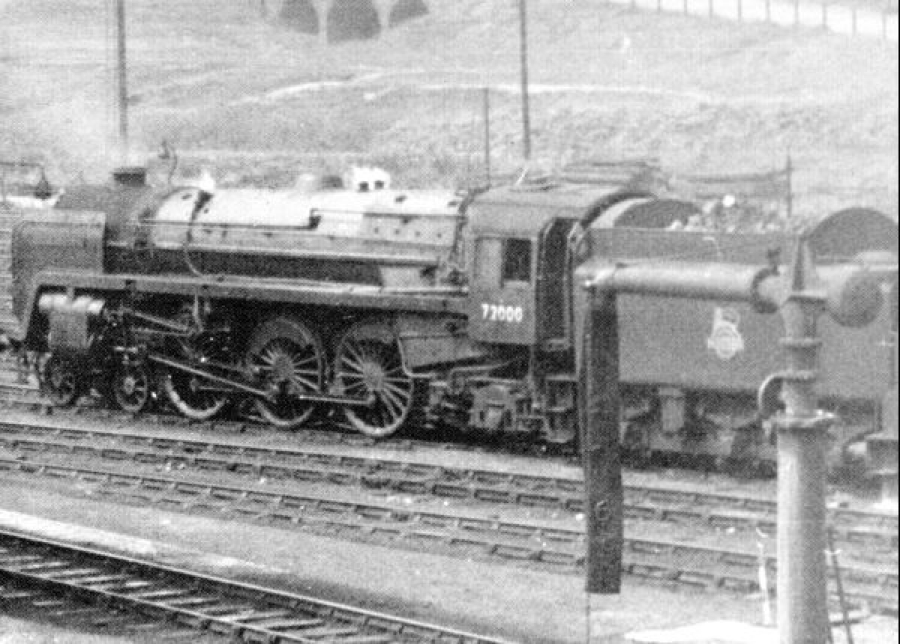
To go back to the beginning, there is one other rarity which to me proves that where steam railways were concerned, you could never guarantee what would happen. For many years I was vilified by my peers because I said I had seen 72000 “Clan Buchanan” at Ryecroft. “Impossible” was the general (more printable) response to my claim that a Polmadie loco had been in town. Thankfully, in 2006 I was finally vindicated by the publication of Jack Haddock’s book “Walsall’s Engine Shed”. There on Page 94 is a picture of 72000 on Ryecroft shed. To me this is just the type of rare working which made trainspotting in the days of steam the wonderful hobby that it was. Almost anything was possible. Was this the occasion that prompted “Uncle Bill” to take me to the shed? I like to think so although only he will know the answer and he has long since gone to that great Engine Shed in the Sky!
I have to say, and I am sure most enthusiasts from the days of steam would agree with me, that these days were made all the more enjoyable by the company of fellow spotters. My own group included brothers Alan and Brian Longdon as well as their schoolmate Malcolm Taylor, along with others whose names have, sadly, slipped from the memory banks. If any are reading this, it would be good to get back in touch and perhaps chew over a few memories of the glory days of steam.
Bibliography:
Moved by Steam – Richard Inwood & Mike Smith – Silver Link Publishing – 978-1-85794-323-8
Walsall’s Engine Shed – Jack Haddock – Tempus Publishing – 0-7524-4034-9
Rails around Walsall – John Boynton – Mid England Books – 0-9522248-3-6
Walsall Local History Centre
My Formative Years – Addendum
The original article was published in Steam World Number 398 – August 2020. Following on from this I was contacted by a fellow Ryecroft devotee, Ian Pell. Ian was kind enough to provide me with some detailed operational information and also some photographs which assist in illustrating a couple of points I made in the article.
First off is this picture of Clan Buchanan on the occasion of its contentious (amongst locals) visit. The date is believed to be either 1955 or 1956. The shot in Jack Haddock’s book is not very definitive and could have been taken at any number of locations. For anyone familiar with Ryecroft, however, this cannot be mistaken. In the right background is Mill Street with its accompanying derelict fence. The bridge at the top of the picture goes over the Walsall – Wolverhampton line which was eventually curtailed at Walsall Power Station before total closure. This was originally a Midland Railway route, albeit with a complicated gestation period. The patch of “waste ground” which was our spotting base is seen this side of that line, with the former South Staffordshire Railway route to Cannock and Rugeley hidden from view alongside the shed. I have yet to discover what caused such an iconic loco to be so far from its Scottish home.
Next on to the evening workman’s train from Duddeston (the station was earlier known as “Vauxhall” and also “Vauxhall and Duddeston”) to Brownhills. In the 1957/58 WTT, it was shown as 17.40 from Vauxhall, passing Ryecroft at 18.17. Below are several photos which Ian passed to me.
Firstly is what was normally expected. 46425 which was photographed on its way to Brownhills having just passed Ryecroft shed which is on the other side of the road overbridge.
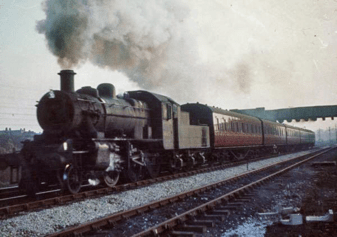
Figure 1 46425 passing Ryecroft
Next up comes sometime Aston favourite – 45593 Kolhapur. I saw this loco several times on this duty. This is on the approach to Ryecroft from Walsall.
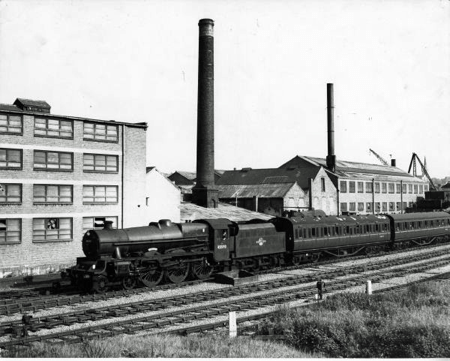
A Stanier 5 mogul comes next. This is an unidentified member of the class but it is likely to be one of Aston’s small allocation.
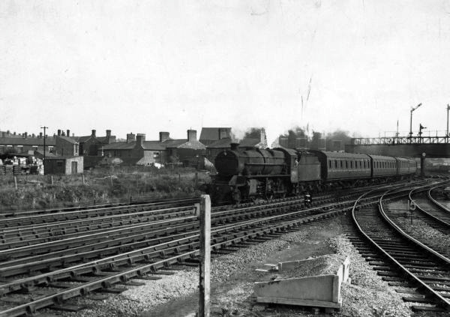
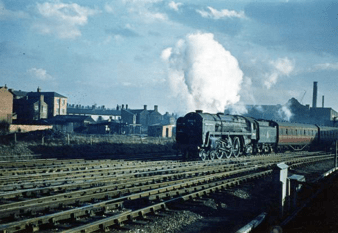
Finally in this section is what we all waited for! 70004 “William Shakespeare. This was an Aston loco for a just a short time in 1962, but whether this photo was taken during that period or not, I suspect we will never know.
A solitary shot of one of the regular Sunday diversions, unfortunately, though, one of the much detested EE Type 4s, later known as Class 40. This is heading through Ryecroft towards Cannock, eventually rejoining the WCML at Rugeley Trent Valley.
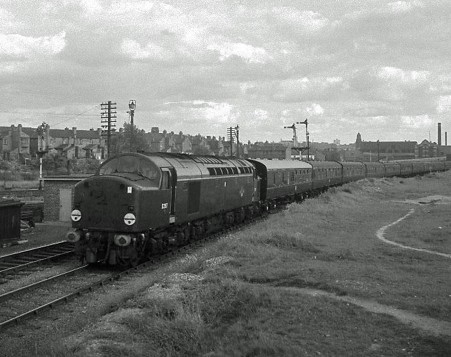
Unfortunately, Ian has since died and hadn’t provide me with any ownership details of these pictures, although I would hazard a guess that they may be from the Jack Haddock collection. However, if anyone claims ownership, please contact me through this website and I will happily give the appropriate credit.
Ryecroft shed closed to steam in 1958 and carried on a very mundane existence as a DMU depot until the mid-sixties. It enjoyed a brief “Indian Summer” in 1966 and 1967 whilst Bescot TMD was being built and it took on responsibility for servicing and maintenance of diesel locos for this period before closing its doors permanently. Below are a couple of my own photos taken during this period.
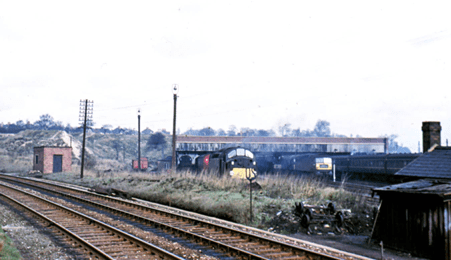
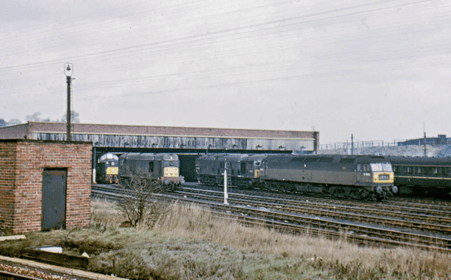
I sincerely hope that everyone has enjoyed my little journey through the mists of time inherent in such a nostalgic trip and agree with me that during the “good old days” of steam that just about anything could turn up anywhere.
Further Bibliography:
A Regional History of the Railways of Great Britain – Volume 7 The West Midlands – Rex Christiansen ISBN 0-946537-00-3
The Midland Railway Route from Wolverhampton – Bob Yate ISBN 978-0-85361-449-4
 Trainspotting data from 1947 until 1980
An excellent read and of special interest to me personally as I worked at Ryecroft until it finally closed. I knew Billy Hackett and worked with him a number of times.
LikeLike
Thanks Graham. I’m really happy to hear from you. Glad that you enjoyed my article. Roger.
LikeLike
Do you know if there is any photographic record of a semi at Bloxwich or other place on the South Staffs line to Rugeley!
thanks for the interesting read and were you a member of Walsall locomotive Society?
Rod king
LikeLike
Hi Rod.
I have emailed your question to Roger, as I was not in the West Midlands during the 1950s/60s. He may reply directly.
Jon
LikeLike